what would it be like to live on venus
In this post I'll expect into the distant time to come and talk about humans living and building settlements on the planet Venus. Considering it is well beyond what we tin can attain with our current technology, it is a topic that been more than in the realm of scientific discipline fiction rather than factual scientific writing. However, even though in that location are many hard obstacles in the manner, I think it is very probable to happen at some point in the afar future.
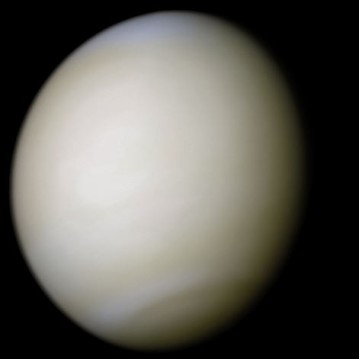
Venus as seen through a telescope – paradigm from NASA.
Why would we want to alive on Venus?
There are a number of reasons why humans would want to colonise Venus. The get-go iii also utilize to the Moon, Mars or Mercury.
- To ensure the continuation of humanity. While the human being species is restricted to life on a single planet it is vulnerable to extinction caused by natural or man made disasters. If humans could alive in a self supporting colony exterior the Globe then this would provide a Programme B to allow the continuation of our species. Indeed the British physicist Stephen Hawking recently said:
"I believe that the long term future of the human race must be space and that information technology represents an important life insurance for our future survival, as it could prevent the disappearance of humanity past colonising other planets."
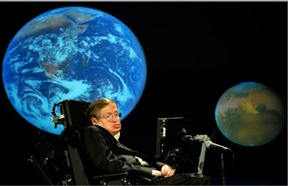
Image from NASA
- To spread human civilisation to other places. Since humans first evolved, they have constantly sought to expand to new territories. It seems to exist almost a biological imperative to find other places to alive. There are not many uninhabited places on Globe, then humans may one day extend their culture beyond our planet.
- To stimulate the economy. Despite the enormous cost, building colonies outside the Earth would give a huge stimulus to the Globe'due south economy. There may well exist spin-offs in the same way that the Apollo programme in the sixties and early seventies led to huge technological developments unconnected to space travel.
- It is relatively easy to get to. Compared to Mars and Mercury, Venus gets closer to the Earth (Williams 2015 a,b). At its closest approach it is forty 1000000 km abroad from Globe, whereas Mars at its closest approach is still around eighty meg km away. It is therefore easier to reach.
- Larger surface surface area. Venus is nigh the same size as the Globe (ibid). This means that information technology has virtually 4 times the surface area of Mars and xv times the surface area of the Moon, giving a greater expanse to colonise.
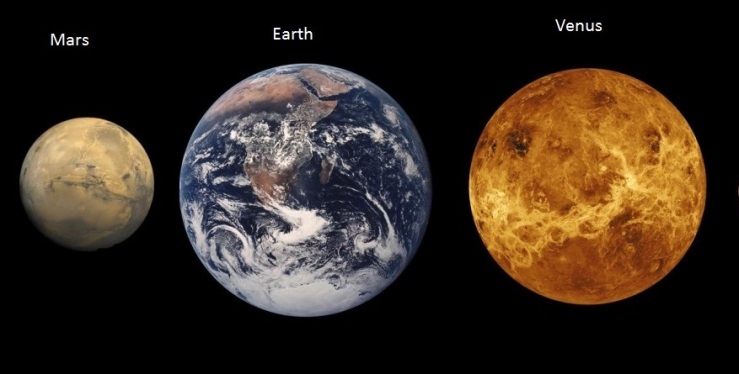
- Similar gravity to the Earth. When astronauts spend long periods of time in a low gravity environment, such as the International Space Station, their bones and muscles weaken. It is not known if the weak gravity on the Moon (16% of the Earth's gravity) or Mars (38% of the World's gravity) would be sufficient to prevent this happening. The surface gravity on Venus is 91% of that of the Earth which would exist sufficient.
- More solar energy. Whatever colony would be likely to use solar free energy equally its main energy source. Venus is closer to the sun than the World and receives roughly twice as much solar energy as the Earth. Run across Notes at the cease of this post.
Obstacles
As readers of my previous mail volition know, Venus is a very inhospitable world. Its surface temperature is on average well-nigh 500 degrees Celsius and its air pressure is a burdensome 92 times that of the Earth. No spacecraft has been able to survive for longer than virtually an hr on its surface without being destroyed by the intense heat and force per unit area. The thick atmosphere forms a thermal blanket around the planet. So fifty-fifty at the poles the temperature is not whatever cooler and, although the temperature drops with altitude, there is nowhere on the planet'southward surface which is less than than 380 degrees Celsius. In addition, at that place is almost no water or oxygen in the atmosphere – both of which are essential for life and Venus does non accept a magnetic field to protect the planet from the harmful effects of the solar wind.
Floating cities?
Because the temperature and pressure level both fall with altitude in that location is a region around fifty km above the planet'southward surface where both the atmospheric pressure and temperature are similar to that on the Earth.

The graph above shows how the temperature and force per unit area of Venus's temper varies with distance (from Wikimedia Common). 1 Bar is air pressure at bounding main level on Earth
At this 50 km indicate, the atmosphere of Venus is the most Earth-like surround, other than Globe itself, in the Solar Arrangement. In a paper written in 2008, the NASA scientist Geoffrey Landis suggested building floating cities in the Venusian atmosphere (Atkinson 2008) . The atmosphere of Venus consists of 97% carbon dioxide, which is denser than the Earth's temper, which is mainly equanimous of nitrogen and oxygen. Landis suggested that a large infinite filled with with breathable air could float loftier above the Venusian surface in the same way that a helium balloon floats in the World'southward atmosphere.
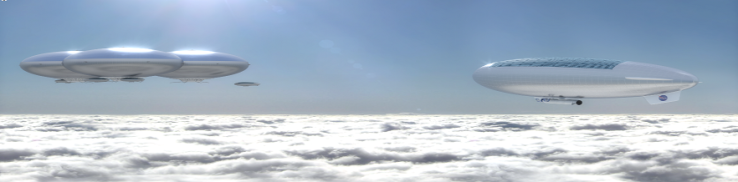
It would be possible to build large enough spaces for humans to live and work in, although at that place is the obvious risk that if at that place were a major leak the entire construction would autumn down to the surface to its destruction.
Terraforming Venus
I think that humans will only be able to live on Venus after the entire planet has been transformed to make it more Earth like. This is called terraforming. This process, which is well across our electric current technology, and is at the moment more in the realm of science fiction writers, will involve removing well-nigh all the carbon dioxide from the atmosphere, adding oxygen, reducing the surface temperature and pressure to like values to those on Earth, and adding water. It volition also exist necessary to exercise something about the long day/night cycles. A day on Venus lasts 116.viii Earth twenty-four hours which is likewise long for World life to suit to. (Incidentally, Mrs Geek recently read and enjoyed Karen Thompson Walker'due south novel "The Age of Miracles" which describes how humanity struggles to adapt to a world in which the length of a day is much longer than 24 hours.)
In my next post I will discuss how, if humanity doesn't destroy itself and we become a very advanced civilisation, we could terraform Venus.
The Scientific discipline Geek
http://www.thesciencegeek.org
https://www.facebook.com/thesciencegeek01/
Notes
Interestingly, the amount of solar energy reaching the surface of Venus is, on average, far less than that reaching the surface of the Globe. This is because, although Venus gets more sunlight, virtually of the solar energy which hits Venus is reflected back into space past the thick cloud layer high above the planet's surface. Virtually of the remaining sunlight is absorbed by the thick atmosphere before it reaches Venus'due south surface. Howver,If Venus is terraformed its surface volition become more sunlight than the Earth, because its clouds and atmosphere will be much thinner.
References
Atkinson N. (2008) Colonizing Venus with floating cities, Available at: http://www.universetoday.com/15570/colonizing-venus-with-floating-cities/ (Accessed: 23 Jan 2016).
Williams D R (2015a) Mars fact sheet, Available at: http://nssdc.gsfc.nasa.gov/planetary/factsheet/marsfact.html (Accessed: 23 January 2016).
Williams D R (2015b) Venus fact sheet, Bachelor at: http://nssdc.gsfc.nasa.gov/planetary/factsheet/venusfact.html (Accessed: 23 Jan 2016).

Source: https://explainingscience.org/2016/01/26/living-on-venus/
0 Response to "what would it be like to live on venus"
Post a Comment